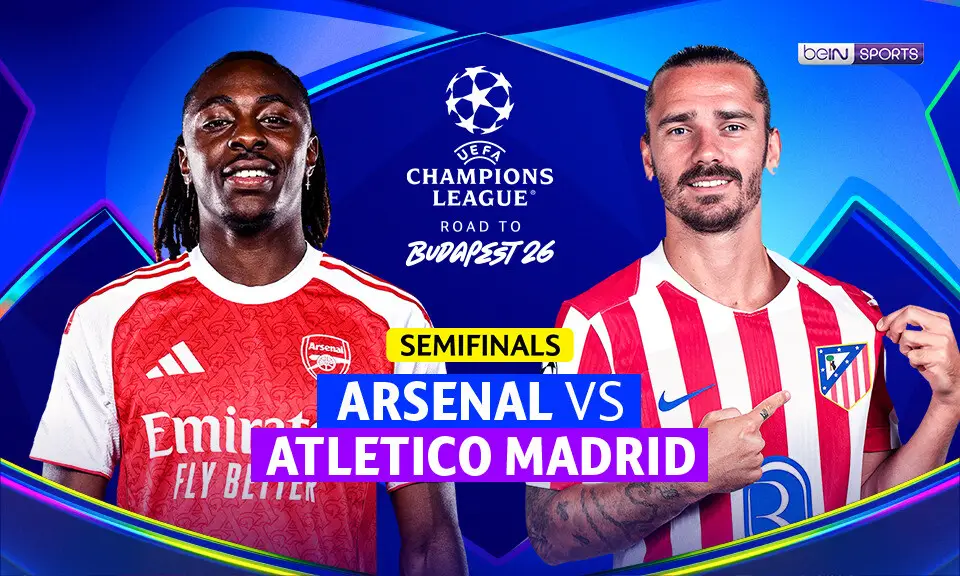
Arsenal vs Atletico Madrid


Champions League
SCHEDULETIME
Match:
Arsenal vs Atletico Madrid

Tournament:UCL - Semi Final
Match Date:May 6 2026
Match Time:12:30 AM IST
 (UTC +5:30)
Stadium:--

SPONSORED


Preview :  Atletico Madrid vs Arsenal


Arsenal FC vs Atlético Madrid is one of those rare matchups where contrasting football philosophies collide in the most intriguing way, making it a highly anticipated contest regardless of competition. Arsenal, under Mikel Arteta, have evolved into a fluid, possession-heavy side that thrives on quick combinations, intelligent movement, and width provided by their full-backs and wingers, often looking to dominate territory and suffocate opponents with sustained pressure. On the other side, Atlético Madrid, led by the ever-disciplined Diego Simeone, remain one of the most tactically resilient teams in world football, built on defensive compactness, structured pressing in key moments, and lethal counter-attacks that can punish even the smallest positional errors. When it comes to head-to-head history, these two sides have only met a handful of times, but their most notable encounters came during the UEFA Europa League 2017–18 semi-finals, where Atlético edged past Arsenal with a 2-1 aggregate victory, showcasing their ability to grind out results even when not dominating possession, a trait that still defines them today. That historical edge, combined with Atlético’s experience in high-pressure knockout ties, adds an extra layer of intrigue heading into this clash.


From a tactical standpoint, the game is likely to revolve around whether Arsenal can effectively break down Atlético’s low defensive block, something many top teams have struggled with over the years. Arsenal’s midfield creativity and attacking rotations will be key, as they try to pull Atlético out of shape, while Simeone’s men will aim to stay compact, deny central spaces, and force Arsenal into wide areas where crosses can be dealt with. In transition, Atlético will look to exploit any gaps left behind by Arsenal’s advancing full-backs, making counter-attacks a major threat throughout the match. The tempo of the game could fluctuate significantly, with Arsenal trying to keep it high and Atlético slowing things down whenever necessary to maintain control. Set-pieces could also play a decisive role, given Atlético’s physical presence and efficiency in such situations.


In terms of prediction, this has all the makings of a tight, tactical battle with very fine margins separating the two sides. Arsenal may enjoy more possession and create more chances, especially if playing at home, but Atlético’s defensive discipline and big-game mentality make them incredibly difficult to beat. It feels like a match that could be decided by a single goal or moment of brilliance, and while Arsenal’s attacking quality gives them a slight edge, writing off Atlético in these scenarios is never wise. A 1-1 draw or a narrow 2-1 win for Arsenal seems the most likely outcome, but extra caution leans toward a stalemate, as Atlético’s ability to frustrate and control high-stakes matches could once again come into play.


ARSENALLineup
 XI

ATLETICOLineup
 XI:


Expected Lineups will be updated closer to kickoff once officially announced.


     Match links Will be Updated Before Kickoff

Watch Live 👇


JOIN FOR MORE MATCHES
🛑 : Join Our WhatsApp Group For Daily Live Links. LINK IN BELOW👇


About UEFA Champions League:

History

The UEFA Champions League (UCL), usually known simply as the Champions League, is an annual club association football competition organised by the Union of European Football Associations (UEFA) that is contested by top-division European clubs. The competition begins with a round robin league phase to qualify for the double-legged knockout rounds, and a single-leg final. It is the most-watched club competition in the world and the third most-watched football competition overall, behind only the FIFA World Cup and the UEFA European Championship. It is one of the most prestigious football tournaments in the world and the most prestigious club competition in European football, played by the national league champions (and, for some nations, one or more runners-up) of their national associations.

Introduced in 1955 as the European Champion Clubs' Cup (French: Coupe des Clubs Champions Européens), and commonly known as the European Cup, it was initially a straight knockout tournament open only to the champions of Europe's domestic leagues, with its winner reckoned as the European club champion. The competition took on its current name in 1992, adding a round-robin group stage in 1991 and allowing multiple entrants from certain countries since the 1997–98 season. While only the winners of many of Europe's national leagues can enter the competition, the top 5 leagues by coefficient provide four teams each by default, with a possibility for additional spots based on performance during the previous season. Clubs that finish below the qualifying spots are eligible for the second-tier UEFA Europa League competition, and since 2021, for the third-tier UEFA Conference League.

In its present format, the Champions League begins in early July with three qualifying rounds and a play-off round, all played over two legs. The seven surviving teams enter the league phase, joining 29 teams qualified in advance. The 36 teams each play eight opponents, four home and four away. The 24 highest-ranked teams proceed to the knockout phase that culminates with the final match in late May or early June. The winner of the Champions League automatically qualifies for the following year's Champions League, the UEFA Super Cup, the FIFA Intercontinental Cup and the FIFA Club World Cup.

Spanish clubs have the most victories (20 wins), followed by England (15 wins), Italy (12 wins), Germany (8 wins), Netherlands (6 wins) and Portugal (4 wins). England has the most winning teams, with six clubs having won the title. The competition has been won by 24 clubs and 13 of them have won it more than once. Since the tournament changed name and structure in 1992, only two top-tier football clubs outside the Big Five European nations (Spain, England, Italy, Germany and France) have also reached the final: Porto (2003–04) and Ajax (1994–95 and 1995–96).

Real Madrid is the most successful club in the tournament's history, having won it 15 times. Madrid is the only club to have won it five times in a row (the first five editions).[11] Only one club has won all of their matches in a single tournament en route to the tournament victory: Bayern Munich in the 2019–20 season. Paris Saint-Germain are the current European champions, having beaten Inter Milan 5–0 in the 2025 final for their first ever title.


Post a Comment

Previous Post Next Post

Join Our WhatsApp Group!

Get updates directly from us.

close

SPONSORED

#SPORTS